Received an energy renewal offer? Learn how to compare it with the Ofgem price cap using your own energy consumption, unit rates and standing charges.
.
Energy Bills
.
7 min read
.
Likewise Compare
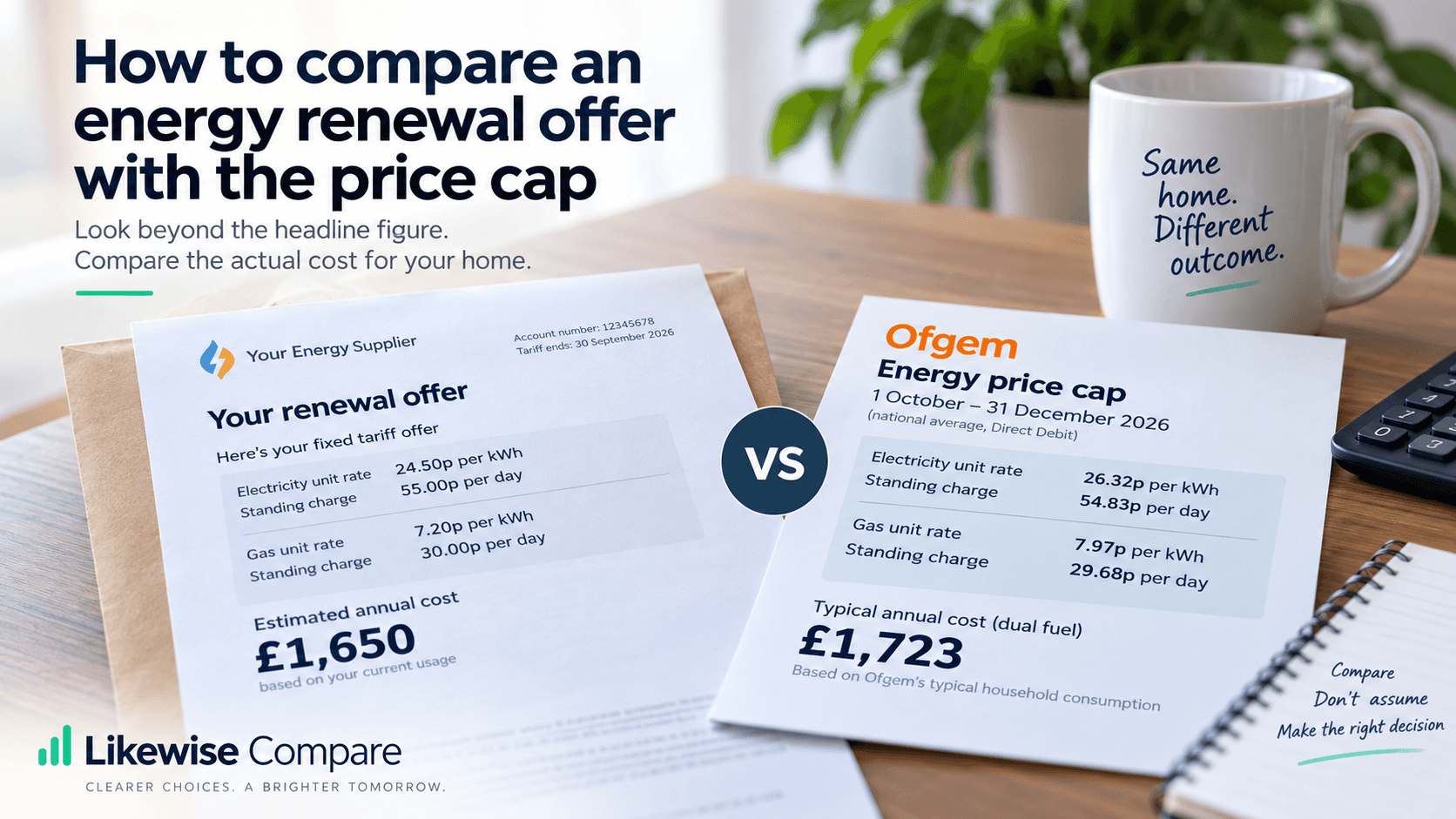
Your energy supplier sends you a renewal offer.
It says your new fixed tariff could cost £1,650 a year.
You have also seen that the Ofgem energy price cap will be £1,723 from 1 October 2026.
So the renewal must be £73 cheaper than the price cap.
Not necessarily.
The £1,723 price cap figure isn't a maximum household bill. And comparing it directly with the annual figure on your renewal offer may not tell you which option would actually cost you less.
To make a meaningful comparison, you need to look beyond the headline figures and compare what each tariff would cost using your own energy consumption.
First, understand what the price cap actually caps
Despite its name, the energy price cap doesn't put a £1,723 ceiling on your annual energy bill.
Ofgem limits the amount suppliers can charge customers on standard variable tariffs through the combination of unit rates and standing charges.
Your unit rate is the price you pay for each kilowatt-hour (kWh) of electricity or gas you use.
Your standing charge is the daily amount you pay regardless of how much energy you consume.
So the more energy you use, the higher your bill can be.
The £1,723 figure for October to December 2026 is based on typical household consumption and average Direct Debit rates across England, Scotland and Wales. It isn't what every household will pay.
What you need from your renewal offer
Before deciding whether a renewal offer is competitive, find:
your electricity unit rate in pence per kWh
your electricity standing charge in pence per day
your gas unit rate and standing charge, if you use gas
your annual electricity and gas consumption in kWh
the tariff start and end dates
any exit fees
The particularly important numbers are your annual electricity and gas consumption.
They allow you to turn tariff rates into a cost relevant to your household, rather than a typical household.
Don't simply compare your renewal with £1,723
There isn't one price-cap unit rate that applies identically to every household.
The actual rates depend on factors including where you live, how you pay and the type of meter you have.
For a standard variable tariff paid by Direct Debit, Ofgem's national-average rates for 1 October to 31 December 2026 are:
Electricity | Gas | |
|---|---|---|
Unit rate | 26.32p/kWh | 7.97p/kWh |
Standing charge | 54.83p/day | 29.68p/day |
These are averages across England, Scotland and Wales. For an actual comparison, you should use the rates applicable to your region and circumstances.
Let's compare a renewal properly
Imagine a household uses:
2,500 kWh of electricity a year
and
9,000 kWh of gas a year.
Now suppose its supplier offers this illustrative fixed renewal tariff:
Renewal offer | Oct price-cap average | |
|---|---|---|
Electricity unit rate | 24.50p/kWh | 26.32p/kWh |
Electricity standing charge | 55.00p/day | 54.83p/day |
Gas unit rate | 7.20p/kWh | 7.97p/kWh |
Gas standing charge | 30.00p/day | 29.68p/day |
The renewal rates above are fictional and are used only to demonstrate the calculation.
Instead of comparing a headline renewal figure with £1,723, we'll apply exactly the same household consumption to both tariffs.
The renewal offer
Electricity
2,500 kWh × 24.50p = £612.50
365 days × 55.00p = £200.75
Electricity total = £813.25
Gas
9,000 kWh × 7.20p = £648.00
365 days × 30.00p = £109.50
Gas total = £757.50
Estimated annual cost: £1,570.75
Now apply exactly the same consumption to Ofgem's national-average October Direct Debit rates.
October price-cap rates
Electricity
2,500 kWh × 26.32p = £658.00
365 days × 54.83p = £200.13
Electricity total = £858.13
Gas
9,000 kWh × 7.97p = £717.30
365 days × 29.68p = £108.33
Gas total = £825.63
Estimated annual cost: £1,683.76
So for this particular household:
Illustrative renewal: £1,570.75
October cap rates: £1,683.76
Difference: £113.01
That's a much more useful comparison.
The household hasn't compared £1,570.75 with the £1,723 headline price cap.
It has taken its own consumption and applied exactly the same usage to both sets of tariff rates.
And notice something else.
Our calculation using the October cap rates produces £1,683.76, not £1,723.
That's because this fictional household doesn't use exactly the same amount of energy as the typical household behind Ofgem's headline figure.
That's why the headline cap shouldn't be treated as your household's expected bill.
Why your result could be different
Give exactly the same renewal tariff to another household and the saving could change.
A small flat using relatively little gas could get one result.
A larger property using substantially more gas could get another.
That's because differences in unit rates become increasingly important as consumption rises, while standing charges are payable every day regardless of consumption.
So instead of asking:
“Is this tariff below the price cap?”
a better question is:
“What would this tariff cost with the amount of energy I actually use?”
But there's another complication: the price cap changes
Our worked example makes one deliberate simplification.
We've annualised the October–December 2026 price-cap rates over 365 days so that the tariffs can be compared on the same basis.
That doesn't mean those cap rates will actually remain in place for a year.
Ofgem reviews the price cap every three months. The October rates apply only from 1 October to 31 December 2026.
A 12-month fixed renewal therefore gives you a known set of rates for a longer period, while future price-cap rates are unknown.
If future caps fall, the fixed tariff may become less attractive.
If future caps rise, fixing could prove more valuable.
That's why comparing a fixed tariff with today's cap isn't a prediction of exactly what you'll save over the next 12 months.
We looked at that question in more detail in Should I fix my energy tariff before October 2026?
What about the annual cost on my renewal letter?
Don't ignore it.
But check what sits behind it.
Look at the annual consumption figures the supplier has used and compare them with your actual or estimated annual usage.
Then look at the underlying unit rates and standing charges.
The annual figure is useful, but the rates and consumption explain how that figure was produced.
A simple renewal checklist
Before accepting a renewal, you should be able to answer:
How much electricity do I use each year?
How much gas do I use each year?
What are my renewal unit rates?
What are my renewal standing charges?
What are the equivalent price-cap rates for my circumstances?
How long is the renewal tariff fixed for?
Are there exit fees?
If you know those things, you can make a much more meaningful comparison than simply putting two headline annual figures next to each other.
Why we're building Likewise Compare
Most people shouldn't have to take a renewal letter, find several different rates, locate their annual consumption and start doing these calculations themselves.
That's part of the problem we're building Likewise Compare to solve.
The aim is simple:
Use the information from your energy bill or renewal to compare what the available options could actually cost you.
And we don't want to start with the assumption that you should switch supplier.
If your existing supplier's offer is the better option, staying should be a perfectly valid result.
If another tariff genuinely offers better value for your circumstances, the comparison should show that too.
The objective isn't to produce the biggest headline saving.
It's to make a fair comparison.
Likewise Compare isn't live yet. Join our waitlist to hear when our first energy renewal comparisons become available.
Sources
Ofgem — Changes to the energy price cap between 1 October and 31 December 2026