A cheaper energy tariff isn't always the one with the lowest unit rate. Learn how unit rates, standing charges and your energy consumption combine to determine what you actually pay.
.
Energy Bills
.
8 min read
.
Likewise Compare
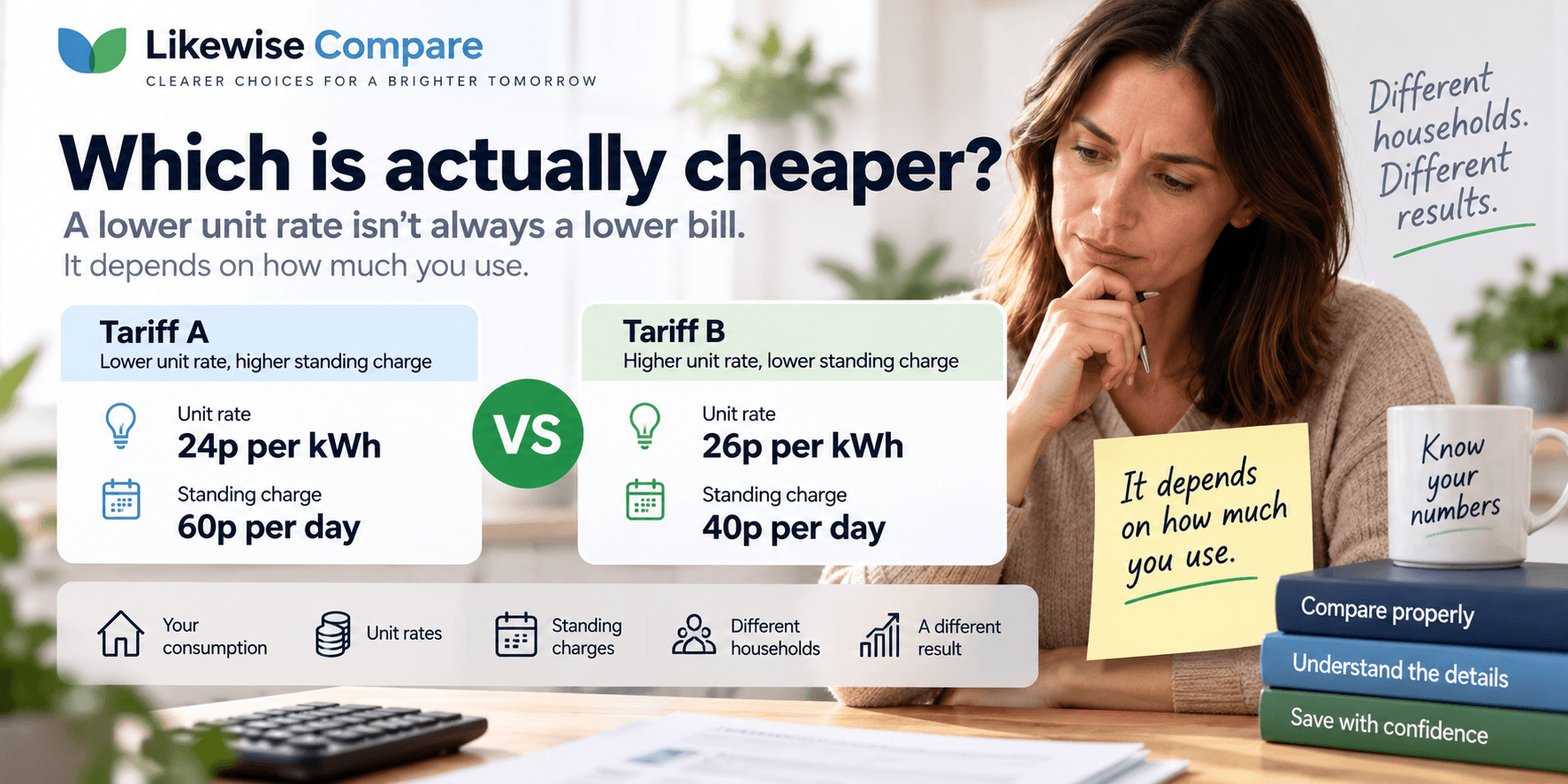
Two energy tariffs can look very similar and still produce different bills.
One might offer a lower electricity unit rate but charge more every day in standing charges.
Another might have a slightly higher unit rate but a much lower standing charge.
So which is cheaper?
The answer depends partly on how much energy you use.
That’s why comparing tariffs using just one number — whether it’s the unit rate, standing charge or an advertised annual cost — can give you an incomplete picture.
To understand what a tariff could actually cost you, you need to look at unit rates and standing charges together.
What is an energy unit rate?
Your unit rate is the amount you’re charged for each kilowatt hour (kWh) of energy you use.
For example, if your electricity unit rate is:
25p per kWh
and you use:
2,500 kWh a year
your electricity usage charge would be:
2,500 × £0.25 = £625
The same principle applies to gas.
The more energy you use, the more important the unit rate becomes.
A difference that looks tiny when expressed in pence per kWh can become significant when multiplied across thousands of kilowatt hours.
What is a standing charge?
A standing charge is a daily amount you pay for being connected to the energy supply.
Unlike the unit rate, it doesn’t depend on how much energy you use.
If your electricity standing charge is:
50p per day
then over 365 days you would pay:
£0.50 × 365 = £182.50
even before using any electricity.
Gas generally has its own standing charge as well.
So for a dual-fuel household, both standing charges need to be included when estimating the total cost of a tariff.
Ofgem explains that standing charges are a fixed daily amount and can cover costs associated with supplying energy to your property and maintaining the energy networks.
Your bill combines both
For a conventional tariff, the basic calculation is:
Energy cost = energy used × unit rate + standing charges
For electricity:
Annual electricity usage × electricity unit rate
+ electricity standing charge × 365
Then repeat the calculation for gas.
This is important because looking at only one part of the tariff can produce the wrong conclusion.
A lower unit rate doesn’t automatically mean a cheaper tariff
Imagine two electricity tariffs.
Tariff A
Unit rate: 24p/kWh
Standing charge: 60p/day
Tariff B
Unit rate: 26p/kWh
Standing charge: 40p/day
At first glance, Tariff A looks attractive because its unit rate is 2p cheaper.
But let’s look at what happens for different households.
Example 1: a lower-energy household
Suppose a household uses:
1,500 kWh of electricity a year
Tariff A
Usage:
1,500 × £0.24 = £360
Standing charge:
365 × £0.60 = £219
Total:
£579
Tariff B
Usage:
1,500 × £0.26 = £390
Standing charge:
365 × £0.40 = £146
Total:
£536
Despite having the higher unit rate, Tariff B is:
£43 cheaper per year
for this household.
Why?
Because at relatively low consumption, the £73 annual difference in standing charges outweighs the extra £30 paid through the higher unit rate.
Example 2: a higher-energy household
Now imagine another household uses:
5,000 kWh of electricity a year.
Tariff A
Usage:
5,000 × £0.24 = £1,200
Standing charge:
£219
Total:
£1,419
Tariff B
Usage:
5,000 × £0.26 = £1,300
Standing charge:
£146
Total:
£1,446
Now the result reverses.
Tariff A is:
£27 cheaper per year
even though its standing charge is considerably higher.
At higher consumption, the lower unit rate has become more important than the standing-charge difference.
There can be a break-even point
This leads to something useful when comparing tariffs.
There can be a level of consumption at which two tariffs cost exactly the same.
Using our example:
Tariff A costs:
24p per kWh + 60p per day
Tariff B costs:
26p per kWh + 40p per day
Tariff A costs an additional:
20p per day
in standing charges.
Over a year, that’s:
£73
But Tariff A saves:
2p for every kWh used.
To recover that additional £73 through the cheaper unit rate:
£73 ÷ £0.02 = 3,650 kWh
So at approximately:
3,650 kWh of annual electricity consumption
the two tariffs cost the same.
Below that level, Tariff B is cheaper.
Above it, Tariff A is cheaper.
This is why there isn’t necessarily a universally “cheapest tariff”.
The answer can depend on the household using it.
Standing charges matter particularly to low users
Because standing charges are payable regardless of consumption, they can make up a larger proportion of the bill for households that use relatively little energy.
Imagine two households on the same tariff.
One uses very little electricity.
The other uses considerably more.
Both still pay the same daily electricity standing charge.
For the low-energy household, that fixed cost therefore represents a larger share of its total electricity bill.
This has been an important issue in the energy market. Ofgem has acknowledged concerns about standing charges, particularly their impact on low-consuming households, and has introduced options intended to give consumers greater choice over how those costs are recovered.
But lower standing charges don’t mean free energy
A tariff with a very low or zero standing charge still has to recover its costs somehow.
That may mean a higher unit rate.
This can potentially work well for some low-use households while being considerably more expensive for households consuming large amounts of energy.
So seeing:
“No standing charge”
doesn’t automatically mean:
“Cheapest tariff.”
The unit rate still matters.
Gas can make the difference even larger
The same calculation applies to gas, but household gas consumption can be much higher in kWh than electricity consumption.
A household might use:
2,500 kWh of electricity
but:
9,000 kWh of gas
over a year.
That means relatively small differences in the gas unit rate can accumulate across thousands of additional kilowatt hours.
For example, a difference of:
0.5p per kWh
across 9,000 kWh is:
£45 a year
before considering standing charges.
This is another reason to compare the complete dual-fuel cost rather than focusing on whichever individual tariff number looks cheapest.
Your own consumption is what connects the two
This is the key point.
A unit rate tells you what each additional kWh costs.
A standing charge tells you what you pay regardless of usage.
Your annual energy consumption determines how those two elements combine.
That combination produces an estimated annual cost, which is much more useful for comparing tariffs than looking at either the unit rate or standing charge on its own.
That’s why the same tariff can be relatively attractive to one household and relatively expensive to another.
It also explains why typical-household figures can be useful illustrations but shouldn’t replace a personalised comparison when your actual consumption is available.
Don’t compare tariffs by unit rate alone, Use the same consumption for every tariff.
That comparison should include offers from your current supplier as well as alternatives elsewhere, because staying with your existing supplier can sometimes be the cheaper option.
When looking at a renewal offer or another tariff, don’t simply ask:
“Which has the lowest unit rate?”
And don’t simply ask:
“Which has the lowest standing charge?”
Instead compare:
electricity unit rate
electricity standing charge
gas unit rate
gas standing charge
your annual electricity consumption
your annual gas consumption
the resulting estimated annual cost
Use the same consumption for every tariff.
That allows the different tariff structures to compete on equal terms.
What about the energy price cap?
The energy price cap limits the amount suppliers can charge per unit of gas and electricity on default tariffs and also limits standing charges. It is not a maximum limit on the total amount a household can pay.
How much you actually pay still depends on how much energy you use.
This is why Ofgem’s headline annual price-cap figure should not be interpreted as everyone’s energy bill.
The underlying unit rates and standing charges — together with your consumption — are what determine your estimated cost.
So which matters more: unit rate or standing charge?
Neither can be considered properly in isolation.
For a very low-energy household, standing charges can have a disproportionately large effect.
As consumption increases, differences in unit rates become increasingly important.
But the best way to compare tariffs isn’t to decide beforehand which number matters most.
It’s to calculate what both numbers together mean for your household.
At Likewise Compare, that’s the principle we’re building around.
Use your actual energy consumption.
Apply it consistently to each tariff.
Include the standing charges.
Then compare the resulting cost.
Because the cheapest-looking rate isn’t necessarily the cheapest tariff for you.
Want to see how different unit rates and standing charges affect your own annual cost? Compare two tariffs using our Energy Tariff Comparison Calculator.
Want to compare what energy tariffs could actually cost you?
Likewise Compare is being built to compare your current or renewal tariff with available alternatives using your own energy consumption, unit rates and standing charges.
The aim is simple: show you what the different options could cost on the same basis — including when staying with your existing supplier is the better choice.